The Tarot de Marseille
Origins, history, and principles of the most widely used deck in cartomancy
The Origins of Tarot
The history of Tarot begins in 15th-century northern Italy. The earliest known cards, the Visconti-Sforza, were commissioned around 1440 by the Duke of Milan for aristocratic card games. These hand-painted cards already depicted the allegorical figures we recognize today: the Magician, the High Priestess, the Empress, the Emperor...
Contrary to popular belief, Tarot has neither Egyptian nor Romani origins. These romantic myths were propagated in the 18th century by Court de Gébelin and Etteilla, the first modern cartomancers. In reality, tarot cards are a product of the European Renaissance, blending Christian symbolism, Neoplatonic philosophy, and Hermetic tradition.
The word 'tarot' itself has a debated etymology. It may derive from the Italian 'tarocchi' (the card game) or the French 'tarot' (a card back pattern). Regardless of its linguistic origin, tarot quickly spread from Italy to France, where it would undergo its most significant development.
The Golden Age: The Tarot de Marseille
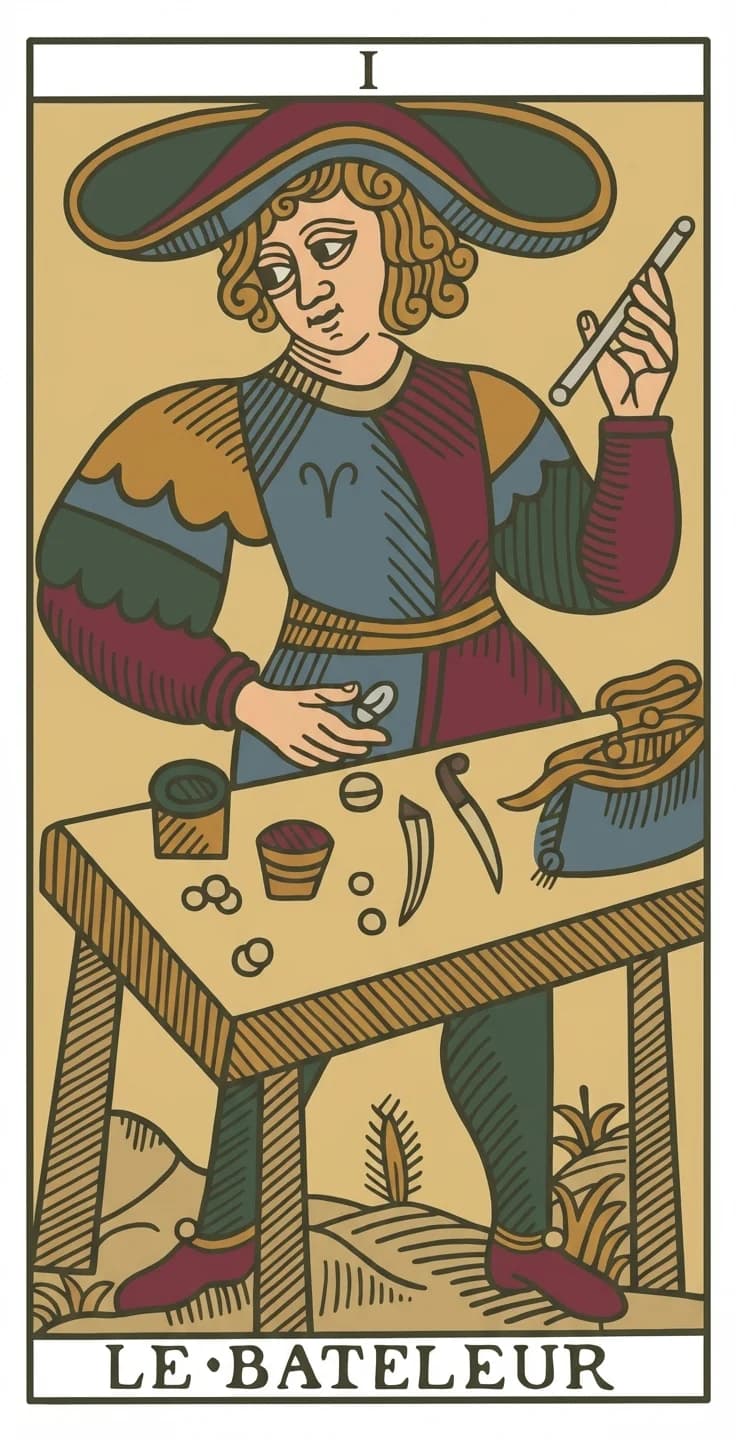
It was in France that the Tarot took its definitive form. The 'Tarot de Marseille' does not necessarily come from Marseille — this name designates a standardized style that established itself between the 17th and 18th centuries. The three major historical versions are:
Jean Noblet (circa 1650, Paris) — The oldest known Marseille-style tarot. His vigorous woodcut prints established the basic iconography. Jean Dodal (circa 1701, Lyon) — A refined version that consolidated the symbolic colors: blue for spirituality, red for action, yellow for intelligence, green for nature.
Nicolas Conver (1760, Marseille) — The reference version, the most faithfully reproduced. This deck gave its name to the 'Tarot de Marseille.' The clarity of its engravings and the balance of its colors make it the standard that most practitioners still use today — and it is the deck that Zodiia has chosen.
Structure of the Tarot
The complete Tarot comprises 78 cards divided into two groups: 22 major arcana and 56 minor arcana. The major arcana — from The Fool (0) to The World (XXI) — represent the great archetypal forces of existence: the initiatory stages, trials, and achievements that mark the human journey.
The 56 minor arcana are divided into four suits (Wands, Cups, Swords, Pentacles) corresponding to the four elements (Fire, Water, Air, Earth). Each suit contains 10 numbered cards and 4 court cards (Page, Knight, Queen, King). The minor arcana describe everyday events and personality nuances.
In modern cartomancy, and particularly in Zodiia's approach, the 22 major arcana are primarily used. These cards concentrate the essential symbolism of the Tarot and allow for deep readings without requiring all 78 cards of the complete deck.
Tarot de Marseille vs Rider-Waite
Two traditions dominate the world of Tarot: the Tarot de Marseille (TdM) and the Rider-Waite-Smith (RWS), created in 1909 by Arthur Edward Waite and illustrated by Pamela Colman Smith. Understanding their differences helps in choosing your deck.
The Tarot de Marseille uses geometric and abstract symbols for the minor arcana (such as repeated patterns of cups or swords), requiring more intuitive interpretation. The Rider-Waite illustrates each card with a narrative scene, making reading more accessible to beginners but sometimes more prescriptive.
The numbering also differs: in the TdM, Justice is arcanum VIII and Strength is arcanum XI. In the RWS, it's reversed. This difference reflects distinct philosophies: the TdM places law before force, the RWS places vital energy before judgment.
Zodiia chose the Tarot de Marseille for its symbolic depth, its centuries-old tradition, and its interpretive openness. Where the RWS 'tells' the story of the card, the TdM invites the querent to find their own story in the symbols.
Cartomancy Today
Cartomancy has evolved considerably in the 21st century. Far from the clichés of a fortune teller in a dark room, tarot reading has become a recognized tool for personal development and introspection. From Jungian psychologists to life coaches, many professionals incorporate Tarot into their practice.
The modern approach to Tarot does not claim to predict the future literally. It uses the archetypes of the cards as mirrors of our unconscious: a way to put images and words to intuitions, fears, or hopes that we struggle to articulate. It is a tool for dialogue with oneself.
With artificial intelligence, a new era opens for cartomancy. Zodiia combines the age-old wisdom of the Tarot de Marseille with the analytical power of AI to offer interpretations that are both respectful of tradition and personalized. AI does not replace intuition — it complements it by suggesting reading angles the querent might not have considered.